
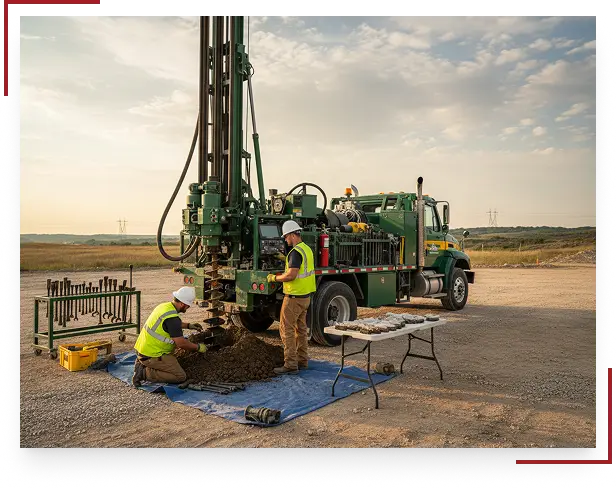
Before designing a foundation, placing a slab, or developing a pavement section, your team needs reliable information about the soil and groundwater below the site. MAK Lonestar provides geotechnical drilling and soil-sampling services throughout the Dallas–Fort Worth Metroplex and surrounding North Texas communities.
We own and operate a CME-55 truck-mounted drill rig for investigations on residential, commercial, industrial, and municipal projects, coordinating each program directly with the project engineer.
REQUEST A DRILLING QUOTE→We coordinate each program with the project engineer to confirm boring locations, depths, sampling intervals, and testing requirements — then capture the right information using appropriate field procedures.
Direct information on subsurface soil, rock, fill, and groundwater conditions, with material changes documented for the project engineer.
Field personnel collect disturbed and relatively undisturbed samples using procedures that preserve sample condition and traceability.
Recovers relatively undisturbed cohesive-soil samples for strength, consolidation, and swell testing as required by the project.
Evaluates the relative density of granular soils and consistency of cohesive soils, providing data for design recommendations.
As drilling progresses, field personnel visually classify samples and document changes in material type and consistency.
Provides an approximate field indication of soil consistency and compressive strength to support field evaluation.
Groundwater is recorded during and after drilling, since it can influence excavation, foundation design, and construction.
Recovered samples are labeled, preserved, and transported to our lab for moisture, Atterberg limits, sieve, swell, and strength testing.
Delays in obtaining subsurface information can affect foundation recommendations, pavement design, permitting, budgeting, and construction schedules. MAK Lonestar coordinates fieldwork around project deadlines and communicates with the team throughout. While every schedule depends on site access, utility clearance, weather, and lab requirements, our goal is to keep the investigation moving efficiently from fieldwork through final reporting.
Talk to Our TeamWe review site location, proposed development, structural loads, and available plans.
Our team proposes a boring plan based on project scope, site conditions, and applicable standards.
Boring locations are cleared for utilities, then our CME-55 rig and crew mobilize to site.
Our crew advances borings, collects samples, performs field tests, and documents subsurface conditions.
Selected samples are tested for classification, strength, swell, moisture, and other required properties.
Field and lab data are reviewed by our geotechnical team, with findings documented in a report when in scope.
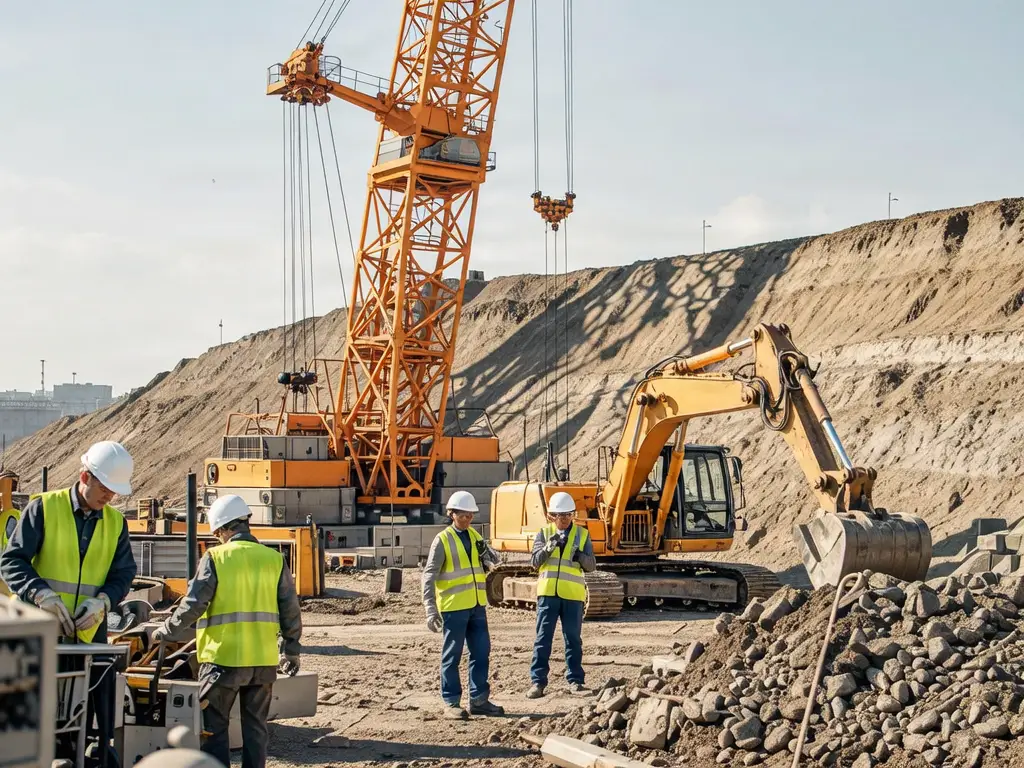
North Texas subsurface conditions vary considerably between sites — expansive clay, weathered rock, undocumented fill, and variable groundwater all affect scope and recommendations. Working with a local, company-owned drilling operation keeps the investigation coordinated and efficient.
Every successful project begins with a clear understanding of the conditions below the surface. Contact MAK Lonestar to discuss drilling services for your residential, commercial, industrial, or municipal project.